

How to Automate WordPress Forms With n8n – Save Hours of Manual Work

I used to spend hours each week moving data from WordPress forms into other tools. I would copy an email address here, paste a phone number there, create a task, and then send a follow-up. It was slow, and I knew there had to be a better way.
Then I discovered the power of workflow automation. WPForms can work with n8n, which means you can send your form entries to thousands of apps using n8n’s workflows and automate what happens after someone submits your form.
This means no more manual data entry, forgotten follow-ups, or wasted time on repetitive tasks.
In this guide, I’ll show you how to connect WPForms with n8n and create automated workflows that save you hours every week. If you’re ready to work smarter, not harder, let’s get started!

TL;DR: In this guide, you will learn how to connect WPForms with n8n to automate your daily tasks. I will show you how to set up the integration and create workflows that instantly send form data to your favorite apps, saving you hours of manual work.
Here’s what I cover in this article:
What Is n8n?
n8n is a powerful workflow automation tool that acts as a bridge between your WordPress site and other apps. Think of it as a digital assistant that takes data from one place (like your contact form) and instantly delivers it to another (like Google Sheets or Slack).
Unlike simple plugins that might only connect to one specific service, n8n allows you to build complex workflows. This means a single form submission can automatically trigger a chain of actions across different apps.
Why Automate Your Forms With n8n?
Manually copying data from emails to spreadsheets or CRMs takes unnecessary time and effort. Automating your forms with n8n eliminates this busy work.
Here are the biggest benefits of using n8n with WPForms:
- Save Time: Automation handles repetitive data entry instantly, freeing you up to focus on growing your business.
- Eliminate Human Error: Manual copying from data often leads to typos and other errors. n8n transfers your data exactly as it was entered, every single time.
- Data Privacy: Because n8n can be self-hosted on your own server, you keep full control over your customer data. This is a huge advantage over other cloud-only tools.
- Complex Workflows: You aren’t limited to simple ‘A to B’ connections. You can filter data, format it, and send it to multiple tools simultaneously using n8n’s visual editor.
In short, using n8n with WPForms gives you the power to build custom automations that fit your specific needs, rather than forcing you to adapt your business to a rigid set of tools. Whether you are a beginner or a developer, it offers the flexibility to handle almost any task you throw at it.
n8n vs. Other Automation Tools
You might be familiar with other automation tools like Zapier or Make.com. While they all serve a similar purpose, n8n stands out in a few key areas.
Here is a quick comparison to help you decide:
| Feature | n8n | Zapier / Make |
|---|---|---|
| Hosting | Cloud or Self-hosted (Your server) | Cloud Only |
| Cost | Free (Self-hosted) or Paid Cloud | Subscription (Can get expensive) |
| Data Privacy | Full Control (Self-hosted only) | Data stored on their cloud |
| Flexibility | High (Custom code & complex logic) | Medium (Linear workflows) |
What You Need to Get Started
Ready to start automating? Here is the checklist of what you will need for this tutorial:
- WPForms Pro License: The n8n integration is a premium addon, so you will need WPForms Pro or higher.
- WPForms Plugin: Ensure you have installed WPForms version 1.9.8.1 or newer.
- n8n Account: You can sign up for a 14-day free trial on n8n.io, or install the self-hosted version on your own server for free.
Once you have these items ready, we can move on to setting up the connection.
How to Build Your Workflow in n8n
Now that you understand how n8n works, let’s start building your first automated workflow. I’ll walk you through each step of setting up n8n to receive data from your WordPress forms.
Step 1: Accessing the n8n Dashboard
First, you need to log in to your n8n account. Head over to n8n.io and sign in with your credentials.
Once you’re logged in, you’ll see the n8n dashboard. This is where you’ll create and manage all your workflows.
To start building a new workflow, click the ‘Start from scratch’ button. This opens the workflow editor where you’ll build your automation.

Step 2: Creating a New Automated Workflow
In the workflow editor, you’ll see a canvas with a ‘+’ icon.
Click this icon to add a new node to your workflow.

A panel will open showing available apps and triggers.
In the search bar, type ‘WPForms’ to find the WPForms Trigger option.

When you see WPForms Trigger in the search results, select it.
You’ll need to click the ‘Install node’ button to add this trigger to your n8n account.

After the installation completes, click ‘Add to workflow’ to insert the WPForms Trigger node into your workflow.
This node listens for form submissions on your WordPress website and starts your automation whenever someone submits a form.

Step 3: Configuring WPForms Triggers in n8n
Once you add the WPForms Trigger node, it will open automatically, showing its configuration settings. If it doesn’t open, simply click on the node to view its settings panel.
Click on the ‘Parameters’ tab at the top of the settings panel. Here, you’ll find the webhook configuration that connects n8n to your WordPress site.

Look for the ‘Webhook URLs’ section and click to expand it. Inside, you’ll see two tabs: Test URL and Production URL.
Open the ‘Production URL’ tab to view the live webhook address. I recommend using the Production URL because it runs 24/7 in the background. The Test URL usually only works while the n8n editor is open and active.

Click on the displayed URL to copy it to your clipboard. You’ll need it in the next step when you set up the connection in WPForms.
Don’t close this n8n tab yet. You’ll need to come back here shortly to complete the connection.
Integrate WPForms with n8n for Powerful Automation
With your n8n workflow ready to receive data, it’s time to connect it to your WordPress forms. This step links your form submissions directly to your automation workflow.
Step 1: Activating n8n Integration in WPForms
In your WordPress dashboard, go to WPForms and either create a new form or open an existing one in the form builder. For this tutorial, you can use any form. Even a simple contact form works perfectly.
Once you’re in the form builder, navigate to Marketing » n8n in the left sidebar.

If you haven’t installed the addon yet, a popup will appear asking you to install it.
Click the ‘Yes, Install and Activate’ button.

Once the addon is installed, you may need to click the n8n menu again to see the settings.
Then, click the ‘Enable n8n Integration’ toggle to turn it on.

When you enable the integration, new settings will appear on your screen.
These include fields for the Webhook URL, Secret Key, Trigger Event, and Field Mapping options.

Step 2: Configuring Integration and Mapping Fields
Now, paste the Production URL you copied from n8n into the ‘Webhook URL’ field in WPForms. Make sure you paste the complete URL without any extra spaces.
After pasting the webhook URL, you will see a ‘Test Connection’ link. You can skip this for now. The test will likely fail because we haven’t added the Secret Key to n8n yet.

Note: If you are working on a localhost site, then the test may fail due to network settings, but your automation will still work.
Next, look for the ‘Secret Key’ field in WPForms. You’ll see a key that WPForms has automatically generated for you. Copy this secret key.
Switch back to your n8n browser tab where your workflow is still open. Find the ‘Secret Key’ field in the WPForms Trigger node settings and paste the key you just copied from WPForms.

This secret key adds an extra layer of security, ensuring that only your WordPress site can trigger this n8n workflow.
Choosing a Trigger Event and Mapping Fields
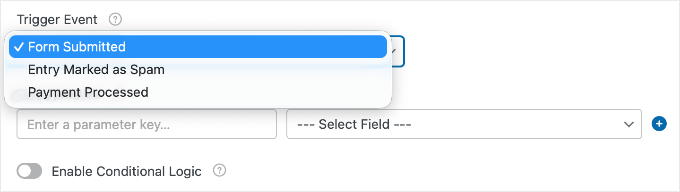
Back in WPForms, look at the ‘Trigger Event’ dropdown. This setting determines when the data is sent to n8n.
You have three options:
- Form Submitted (Recommended): Runs the workflow every time a form is submitted.
- Entry Marked as Spam: Only runs when a submission is flagged as spam.
- Payment Processed: Only runs after a successful payment (useful for order forms and payment forms).
Finally, we need to tell n8n which data to capture. Scroll down to the Field Mapping section.
You need to create a ‘Parameter Key’ (a label) for each field you want to send. For example, to send the user’s email, type email as the key and select the ‘Email’ field from the dropdown.
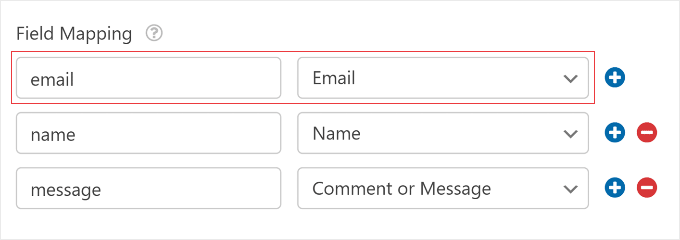
I recommend using simple, lowercase labels so they are easy to recognize when you build your workflow.
Click the blue ‘+’ button to add more rows for other fields, such as Name or Phone Number. Once you have mapped your fields, click ‘Save’ in the form builder.
Quick Tip: Later, when you configure your action nodes in n8n (like Google Sheets), you will see these keys listed on the left side of the screen. You can simply drag and drop the key (like ’email’) into your action settings to use that data instantly.
Step 3: Adding Actions and Activating the Workflow
For the next step, head back to n8n.
Once you’ve pasted the secret key, close the WPForms Trigger node popup. Your form is now connected, but n8n doesn’t know what to do with the data yet. You need to add an Action node.
Hover over the right side of your WPForms node and click the plus (+) button. This opens a menu where you can search for the app you want to send data to.

Here are a few popular automations you can try right away:
- Google Sheets: Search for ‘Google Sheets‘ to automatically add a new row for every form entry.
- Slack / Microsoft Teams: Search for your team chat app to send a notification message whenever you get a new lead.
- Email Marketing: Search for ‘Mailchimp’, ‘ActiveCampaign‘, or your preferred provider to instantly subscribe new users.
Important: For these apps to work, you must give n8n permission to access your accounts. Double-click any node you add and look for the ‘Credential’ or ‘Authentication’ section. Follow the prompts to sign in (like logging into Google) or paste your API key.
Once you have configured your action nodes, click the ‘Save’ icon in the top-right corner. Then, look for the ‘Active’ switch and toggle it to the ‘Active’ (green) position.

That’s it! Your n8n workflow is now live and will run automatically in the background whenever someone submits your form.
Testing and Finalizing Your Automated Workflow
Before you start relying on your automation, it’s important to test everything to make sure it works correctly. I always test my workflows before going live because it saves headaches later.
In your n8n workflow editor, click the ‘Execute workflow’ button near the bottom of the screen.
Important: You must click this button before you submit the form on your WordPress site. This puts n8n into “listening” mode so it can capture your test submission.

Now, switch to your WordPress site and submit a test entry through your form. Fill out all the fields just like a real visitor would.
Back in n8n, check if your workflow received the test data. You should see the form information appear in your workflow, showing that the connection is working properly.
If you don’t see the data, you can double-check these common issues:
- Make sure your workflow is active (the toggle in the top-right corner should be on).
- Verify that the webhook URL in WPForms matches exactly what’s shown in n8n.
- Confirm that your field mappings are set up correctly in WPForms.
Once your test submission is successful, try submitting another form entry to ensure the automation runs consistently. If everything works twice in a row, then you’re all set.
Frequently Asked Questions About Automating Forms With n8n
Automating forms with n8n can improve your productivity and the flow of data across your applications. Here are some frequently asked questions that people also search for when looking for information on this topic.
1. Can I stop WPForms from saving entries to my site?
Yes, you can prevent WPForms from storing form entries in your WordPress database when using the n8n addon. To do this, navigate to Settings » General within the WPForms form builder, then locate the Advanced section and enable the option labeled ‘Disable storing entry information in WordPress’ to prevent entries from being saved to your site’s database.
2. What happens if the WPForms node is removed from my n8n workflow?
If the WPForms node is deleted or removed from your n8n workflow, your forms will no longer trigger the workflow as designed. To fix this, you’ll need to add a new WPForms Trigger node to your workflow, copy its new Production URL, and update the Webhook URL in your WPForms form builder to re-establish the connection.
3. Can I use n8n for free with WPForms?
While n8n offers a free self-hosted option, using the n8n addon with WPForms requires a WPForms Pro license or higher. This ensures you have access to all the premium features needed for the powerful automation offered by n8n.
4. What kind of tasks can I automate using n8n with WPForms?
n8n lets you automate a wide range of tasks with WPForms. Common examples include sending follow-up emails after form submissions, triggering custom notifications to user devices, updating records in your CRM, and handling payment confirmations to streamline various business processes.
Additional Resources for WordPress Forms and Automation
I hope this article helped you learn how to automate your WordPress forms with n8n. You might like to see these additional resources to expand your knowledge about WPForms and WordPress automation:
If you liked this article, then please subscribe to our YouTube Channel for WordPress video tutorials. You can also find us on Twitter and Facebook.


